Showing posts with label Mary. Show all posts

Thursday, November 8, 2012

The Most Blessed Virgin Mary, the Handmaid of the Lord:
Mother of God, Daughter of her Son

A. The Major Marian Doctrines
(1) Immaculate Conception – “Full of Grace”
Mary is the “New Eve,” who was redeemed and given the life of grace from the first moment of her conception, so that she was preserved from Original Sin or other sin in her life. The grace won by Christ on the Cross was applied to Mary in anticipation of this saving event. In this way, Mary could be a proper and pure “living temple” for the Son of God in her womb. "She is the living house of God, who does not dwell in buildings of stone but in the heart of living man." – Pope Benedict XVI. It was this fullness of grace that gave Mary the total freedom, unimpaired by the errors of sin, to say “yes” to God at the Annunciation and throughout her life.

(2) Ever Virgin
The virgin birth of Jesus goes beyond merely demonstrating that the true Father of Jesus is God, not a man. Mary gave herself to God completely, in the entirety of her being, soul and body, including her perpetual virginity. This means that Mary was a virgin before the conception and birth of Jesus, during these events, and after these events. At once virgin and mother, Mary is the symbol and the most perfect realization of the Church, our pure and holy mother of all on earth.

(3) Theotókos, the Mother of God
Mary is not merely mother of Jesus in His humanity or merely mother of the Christ, but is rightly called the Mother of God because Jesus is one, both fully human and fully God. The Lord dwelling within her, she is a living temple and Ark of the Covenant.

(4) Bodily Assumption into Heaven
At the end of her earthly life, Mary was assumed, body and soul, into heaven. She did not experience the corruption of the grave. Jesus being eternal, just as He is forever on the Cross, so too is He forever in the womb of Mary, and she is forever joined to Christ, so that if He is in heaven in the entirety of His being, soul and body, so too must Mary be in heaven in the entirety of her being, soul and body. The bodily assumption of Mary also points the way to all the faithful in the resurrection of the body.
B. Mother of the Church, wholly united with her Son
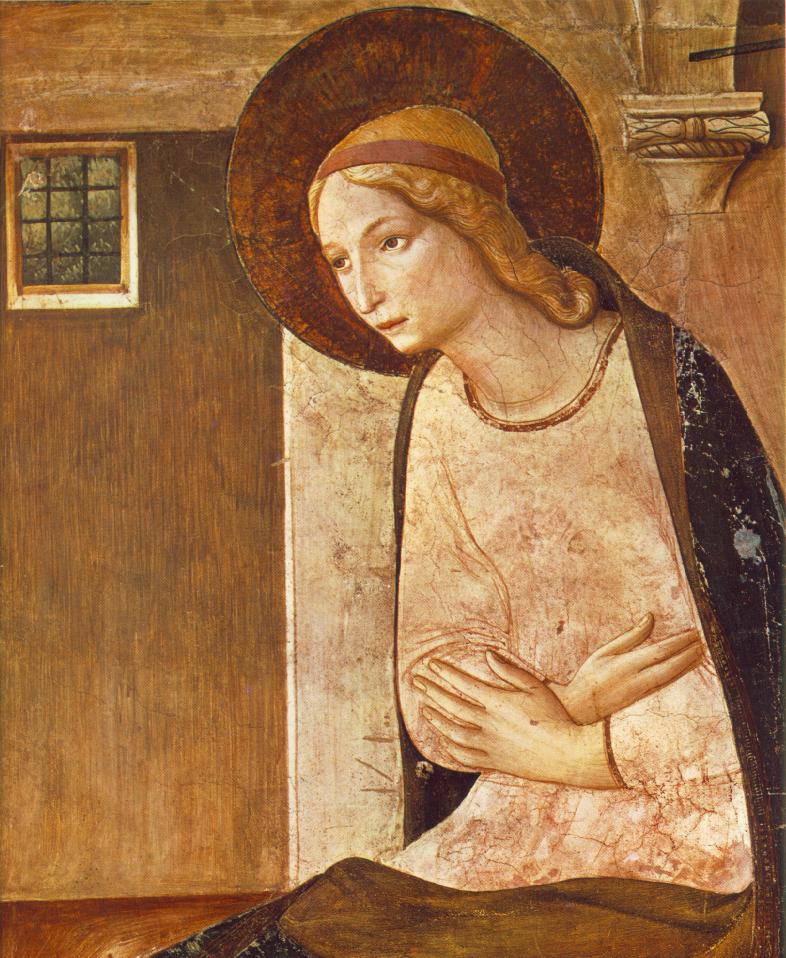
(1) The Annunciation
"This scene is perhaps the pivotal moment in the history of God's relationship with his people. During the Old Testament, God revealed himself partially, gradually, as we all do in our personal relationships. It took time for the chosen people to develop their relationship with God. The Covenant with Israel was like a period of courtship, a long engagement. Then came the definitive moment, the moment of marriage, the establishment of a new and everlasting covenant. As Mary stood before the Lord, she represented the whole of humanity. In the angel's message, it was as if God made a marriage proposal to the human race. And in our name, Mary said ‘yes.’” – Pope Benedict XVI
In Jesus, God literally merged into mankind, becoming small, defenseless, and vulnerable while dwelling within the Virgin Mary’s womb, in the most intimate of relationships. Just as the first Eve was formed out of the first Adam, so Jesus, Son of God and the new Adam, was formed out of the new Eve, flesh of her flesh, bone of her bone.

(2) The Nativity of Our Lord
In the birth of Jesus, we not only see a God who has made Himself small, we see a God who has a face, and it is the face of His mother, Mary, who had carried Him in her womb. To show that such an intimate relationship with Jesus was not meant to be Mary's alone, to show that all the faithful are called to intimately receive Him into our own bodies, the newborn Jesus was placed in a manger. As with the straw that was food for the animals, so too Jesus is shown to be food for us in the Eucharist. And by becoming small in this way, the all-powerful God who needs nothing chose to need us, chose to need our help in bringing about the salvation of man.

(3) The Hidden Life of the Holy Family
The persons closest to Jesus are Mary and Joseph, who raised Jesus, fed Him, clothed Him, taught Him, including instruction in the Faith, and who comforted Him when He needed comforting. They devoted the entirety of their lives to guarding and protecting Jesus, and thereby join in His mission of redemption.

(4) Wedding at Cana
Mary, the handmaid of the Lord, by becoming His mother, became our mother too. As our Mother, like at Cana when the wine ran out, Mary is sensitive and attentive to our needs, and she intercedes and asks her Son to provide for us. (Jn. 2:1-5)

(5) Mother of Sorrows – Mother of Mercy
When the baby Jesus was presented to the Lord in the Temple, the righteous Simeon came to Mary and prophesied that a “sword would pierce her heart,” that is, she would know sorrow. Indeed, soon thereafter, Herod sought to kill Jesus and they were forced to flee to Egypt. During the Passion of her Son, Mary and faithfully persevered in her union with Him. There she stood, in keeping with the divine plan, enduring with her only begotten Son the intensity of His suffering, joining herself with His sacrifice in her mother's heart.

(6) Pentecost and the Early Church
Mary is the New Eve, the mother of all who live according to the life of grace. Jesus gave Mary to His followers to be our mother. She is the mother of the Church. Mary was present, praying with the Apostles and other disciples at Pentecost, when the Holy Spirit descended upon the faithful and the Church was born. “Mary is so interwoven in the great mystery of the Church that she and the Church are inseparable, just as she and Christ are inseparable. Mary mirrors the Church, anticipates the Church in her person, and in all the turbulence that affects the suffering, struggling Church she always remains the Star of salvation.” – Pope Benedict XVI

(7) Mary and Us
“Dear young people, we too must remain faithful to the ‘yes’ that we have given to the Lord's offer of friendship. We know that He will never abandon us. We know that He will always sustain us through the gifts of the Spirit. Mary accepted the Lord's ‘proposal’ in our name. So let us turn to her and ask her to guide us as we struggle to remain faithful to the life-giving relationship that God has established with each one of us. She is our example and our inspiration, she intercedes for us with her Son, and with a mother's love she shields us from harm.” – Pope Benedict XVI
Saturday, November 3, 2012

Episode Four of Catholicism:
Our Tainted Nature’s Solitary Boast - Mary, the Mother of God

This Thursday, November 8, 2012, Cinema Catechism returns with a showing of Episode Four of Fr. Barron's Catholicism series, Our Tainted Nature’s Solitary Boast - Mary, the Mother of God, together with further discussion and reflections on Immaculate Mary, the Virgin Mother, assumed body and soul into heaven: the New Eve, Full of Grace, who carries the Lord within her and points us toward her Son while also pointing us toward our true selves, the people that God intended and intends for us to be in the fullness of Love and Truth.


The Inexhaustibly Rich Figure of Mary
Fr. Robert Barron
Word on Fire Catholic Ministries
Mary is a rich and multivalent figure in all of the Gospels. In Luke’s infancy narrative, she emerges as the spokesperson for ancient Israel, speaking, in her Magnificat, in the words and cadences of Hannah; and as the recipient of an angelic announcement of a miraculous birth, she calls to mind not only Hannah but also Sarah and the mother of Samson as well. In Matthew’s Christmas account, she is compelled to go into exile in Egypt and is then called back to her home, recapitulating thereby the journey of Israel from slavery to freedom. She is thus the symbolic embodiment of faithful and patient Israel, longing for deliverance. In John’s Gospel, she is, above all, mother—the physical mother of Jesus and, through him, the mother of all who would come to new life in him. As mother of the Lord, she is, once again, Israel, that entire series of events and system of ideas from which Jesus emerged and in terms of which he alone becomes intelligible. Hans Urs von Balthasar comments in the same vein that Mary effectively awakened the messianic consciousness of Jesus through her recounting of the story of Israel to her son. So in the Cana narrative, Mary will speak the pain and hope of the chosen people, scattered and longing for union.

(excerpted from: Robert Barron, The Priority of Christ)


Saturday, October 13, 2012

Her Immaculate Heart Will Triumph

Today is the 13th day of October, the day that Our Lady of Fatima made her final appearance to the humble shepherd children Lucia, Francisco, and Jacinta, the day that a reported 70,000 people witnessed the "Miracle of the Sun." At that time, 1917, the world was suffering horribly in the slaughter of so many millions of people in World War I and our Lady warned of even worse horrors and death in a war that was to follow. Nevertheless, with a call for prayer and penance, she promised that her Immaculate Heart would triumph in the end. This is a very important thing to keep in mind as we engage in the New Evangelization.

People have generally interpreted this warning of a greater war as referring to World War II, but since the "third secret" of Fatima was disclosed, we can understand the warning in even broader terms, that is, in long-term historical and eschatological terms, especially with respect to the Church and the faithful. Sister Lucia reports this third part of the vision, which had been revealed to her on July 13, 1917, in these words:
After the two parts which I have already explained, at the left of Our Lady and a little above, we saw an Angel with a flaming sword in his left hand; flashing, it gave out flames that looked as though they would set the world on fire; but they died out in contact with the splendour that Our Lady radiated towards him from her right hand: pointing to the earth with his right hand, the Angel cried out in a loud voice: ‘Penance, Penance, Penance!'

And we saw in an immense light that is God: ‘something similar to how people appear in a mirror when they pass in front of it' a Bishop dressed in White ‘we had the impression that it was the Holy Father'. Other Bishops, Priests, men and women Religious going up a steep mountain, at the top of which there was a big Cross of rough-hewn trunks as of a cork-tree with the bark; before reaching there the Holy Father passed through a big city half in ruins and half trembling with halting step, afflicted with pain and sorrow, he prayed for the souls of the corpses he met on his way; having reached the top of the mountain, on his knees at the foot of the big Cross he was killed by a group of soldiers who fired bullets and arrows at him, and in the same way there died one after another the other Bishops, Priests, men and women Religious, and various lay people of different ranks and positions.

Beneath the two arms of the Cross there were two Angels each with a crystal aspersorium in his hand, in which they gathered up the blood of the Martyrs and with it sprinkled the souls that were making their way to God.
Tuy-3-1-1944
Blessed Pope John Paul II was shot, yet saved from death, on May 13, 1981, the anniversary of the first apparition. He famously attributed his survival of the shooting to Our Lady of Fatima, saying that one hand fired the gun, but another one guided the bullet.

As with interpreting the warning of a greater war to mean World War II, people have generally interpreted John Paul II as being the bishop dressed in white who is shot. But again, we can understand it in a broader sense. "We would be mistaken to think that Fatima’s prophetic mission is complete," Pope Benedict said during a visit to Fatima on May 13, 2010. Rather, humanity will continue to endure great hardship and suffering, hence the urgent need of the Church to offer people hope and proclaim "Repent and believe the Good News" of Jesus Christ (Mk 1:15). The faithful of the Church especially will suffer hardships, persecutions, and even martyrdom in professing Christ, as promised by Jesus Himself and as made clear in the Book of Revelation.

Although the whole purpose of the New Evangelization is to try to find more effective ways to proclaim the Gospel and spread the faith, starting with ourselves, so that we might help the Lord in the work of salvation, converting repentent hearts to His Love and Truth, the fact is that the world is often resistant to the light of love and truth. We are often resistant to it ourselves. And many times the response to our proposal is not merely polite rejection, but persecution. So we ought not be discouraged if we are rebuffed, but instead expect that such things will happen, and we must avoid the temptation of looking for immediate "success" in large numbers.
If you belonged to the world, the world would love its own; but because you do not belong to the world, and I have chosen you out of the world, the world hates you. Remember the word I spoke to you, "No slave is greater than his master." If they persecuted me, they will also persecute you. (Jn 15:19-20)

They will hand you over to persecution, and they will kill you. You will be hated by all nations because of my name. And then many will be led into sin; they will betray and hate one another. Many false prophets will arise and deceive many; and because of the increase of evildoing, the love of many will grow cold. But the one who perseveres to the end will be saved. (Mt 24:9-13)
We ought to expect persecution in response to the New Evangelization. Indeed, hardships are already imposed upon the faithful throughout the world because of that faith -- the 20th century saw more Christian martyrs than any century before it -- and here in the United States, we might not be facing death, but most certainly we are afflicted with persecution of economic, legal, and political natures.

Yet, "blessed are you when they insult you and persecute you and utter every kind of evil against you falsely because of [Jesus]." (Mt 5:11) We have hope, real hope, which makes it possible to even rejoice in persecution and suffering.
Let us now examine more closely the single images [of the vision in the third secret of Fatima]. The angel with the flaming sword on the left of the Mother of God recalls similar images in the Book of Revelation. This represents the threat of judgment which looms over the world. Today the prospect that the world might be reduced to ashes by a sea of fire no longer seems pure fantasy: man himself, with his inventions, has forged the flaming sword.

The vision then shows the power which stands opposed to the force of destruction — the splendour of the Mother of God and, stemming from this in a certain way, the summons to penance. In this way, the importance of human freedom is underlined: the future is not in fact unchangeably set, and the image which the children saw is in no way a film preview of a future in which nothing can be changed. Indeed, the whole point of the vision is to bring freedom onto the scene and to steer freedom in a positive direction. The purpose of the vision is not to show a film of an irrevocably fixed future. Its meaning is exactly the opposite: it is meant to mobilize the forces of change in the right direction. (Joseph Cardinal Ratzinger, Theological Commentary on Fatima)
There is great hardship and suffering in the world. Yet, we do not despair because Jesus came to save us from death and destruction. Evil and suffering, while common throughout human history, will not have the last word. It is not set in stone that mankind will forever suffer. We have hope. Not the "hope" of wishes and grasping at straws, but of trustworthy confidence and assured expectation of salvation. (Spe Salvi)

We are asked to help Jesus in the work of salvation, which means enduring the Passion, it means embracing the Cross, but it is through the Passion and the Cross that suffering and death are transformed to joy and eternal life. In walking the way of the Cross with Him, taking upon ourselves what is lacking in the afflictions of Christ and suffering with Him (Col 1:24), we are comforted by being accompanied by our Blessed Mother, just as she accompanied her Son in sorrow. Mary points to her Son, exhorting people to pray and repent, to "do whatever He tells you" so that your hardship might be turned to joy. (Jn 2:5)
Let us now consider the individual images which follow in the text of the "secret." The place of the action is described in three symbols: a steep mountain, a great city reduced to ruins and finally a large rough-hewn cross. The mountain and city symbolize the arena of human history: history as an arduous ascent to the summit, history as the arena of human creativity and social harmony, but at the same time a place of destruction, where man actually destroys the fruits of his own work. The city can be the place of communion and progress, but also of danger and the most extreme menace. On the mountain stands the cross—the goal and guide of history. The cross transforms destruction into salvation; it stands as a sign of history's misery but also as a promise for history.

At this point human persons appear: the Bishop dressed in white ("we had the impression that it was the Holy Father" [Sister Lucia later said]), other Bishops, priests, men and women Religious, and men and women of different ranks and social positions. The Pope seems to precede the others, trembling and suffering because of all the horrors around him. Not only do the houses of the city lie half in ruins, but he makes his way among the corpses of the dead. The Church's path is thus described as a Via Crucis, as a journey through a time of violence, destruction and persecution. The history of an entire century can be seen represented in this image. Just as the places of the earth are synthetically described in the two images of the mountain and the city, and are directed towards the cross, so too time is presented in a compressed way. In the vision we can recognize the last century as a century of martyrs, a century of suffering and persecution for the Church, a century of World Wars and the many local wars which filled the last fifty years and have inflicted unprecedented forms of cruelty. In the “mirror” of this vision we see passing before us the witnesses of the faith decade by decade. . . .

In the vision, the Pope too is killed along with the martyrs. When, after the attempted assassination on 13 May 1981, the Holy Father [Pope John Paul] had the text of the third part of the "secret" brought to him, was it not inevitable that he should see in it his own fate? He had been very close to death, and he himself explained his survival in the following words: "... it was a mother's hand that guided the bullet's path and in his throes the Pope halted at the threshold of death" (13 May 1994). That here "a mother's hand" had deflected the fateful bullet only shows once more that there is no immutable destiny, that faith and prayer are forces which can influence history and that in the end prayer is more powerful than bullets and faith more powerful than armies.

The concluding part of the "secret" uses images which Lucia may have seen in devotional books and which draw their inspiration from long-standing intuitions of faith. It is a consoling vision, which seeks to open a history of blood and tears to the healing power of God. Beneath the arms of the cross, angels gather up the blood of the martyrs, and with it they give life to the souls making their way to God. Here, the blood of Christ and the blood of the martyrs are considered as one: the blood of the martyrs runs down from the arms of the cross. . . .

Therefore, the vision of the third part of the "secret," so distressing at first, concludes with an image of hope: no suffering is in vain, and it is a suffering Church, a Church of martyrs, which becomes a sign-post for man in his search for God. (Joseph Cardinal Ratzinger, Theological Commentary on Fatima)
As in Revelation, the ultimate message of Fatima is this: Humanity will necessarily suffer great hardship in this world, but God has not abandoned us.

The Lady in white, clothed as with the sun, asks us to help her Son in the work of salvation, including prayer, penance, and redemptive suffering, not merely for ourselves, but for the salvation of others, for their conversion away from sin to embracing holiness. The faithful will suffer and even be hated and persecuted for this, but all this is beatitude (Mt. 5:3-10). We can expect a degree of suffering and persecution if we dare to engage with the world in the New Evangelization. Yet, in the end, notwithstanding all of the great evils that are thrust upon us, her Immaculate Heart will triumph.

The Immaculate Mother of God walks with us and with her pure Virgin heart, a heart full of the love and grace of God, she guides us to her Son. Our Lady of Fatima is Our Lady of hope, with her we have the comfort and assurance that good will prevail, that Love and Truth will triumph.
The Heart open to God, purified by contemplation of God, is stronger than guns and weapons of every kind. The fiat of Mary, the word of her heart, has changed the history of the world, because it brought the Saviour into the world—because, thanks to her Yes, God could become man in our world and remains so for all time.

The Evil One has power in this world, as we see and experience continually; he has power because our freedom continually lets itself be led away from God. But since God himself took a human heart and has thus steered human freedom towards what is good, the freedom to choose evil no longer has the last word. From that time forth, the word that prevails is this: "In the world you will have tribulation, but take heart; I have overcome the world" (Jn 16:33). The message of Fatima invites us to trust in this promise. (Joseph Cardinal Ratzinger, Theological Commentary on Fatima)


The 13th Day (2009) a film by Ian and Dominic Higgins
In a world torn apart by persecution, war and oppression, 3 children were chosen to offer a message of hope to the world. Based on the memoirs of the oldest Seer, Lucia Santos, and many thousands of independent eye-witness accounts, The 13th Day dramatizes the TRUE story of three young shepherds who experienced six interactive apparitions with a “Lady from Heaven” between May and October 1917, which culminated into the final prophesized Miracle. . . . Stylistically beautiful and technically innovative, writer-directors Ian & Dominic Higgins use state-of-the-art digital effects to create stunning images of the visions and the final miracle that have never before been fully realized on screen. Shot on location in Portugal and in the UK, 13th Day Films worked with a cast of over 250 to re-create the scenes of the 70,000 strong crowds, and 3 Portuguese children play the iconic roles of the Seers. Witness the greatest miracle of the 20th Century, and experience the incredible, emotionally-charged and often harrowing world of three young children whose choice to remain loyal to their beliefs, even in the face of death, would inspire thousands.

Monday, May 14, 2012

Mother of Mercy, Our Life, Our Sweetness, and Our Hope

Yesterday was Mother's Day, but let us stay with our dear Blessed Mother Mary and her loving son Karol for a while longer.

Encyclical Letter Veritatis Splendor
His Holiness Pope John Paul II
Feast of the Transfiguration of the Lord, August 6, 1993
Mary, Mother of Mercy

118. Let us entrust ourselves, the sufferings and the joys of our life, the moral life of believers and people of good will, and the research of moralists, to Mary, Mother of God and Mother of Mercy.

Mary is Mother of Mercy because her Son, Jesus Christ, was sent by the Father as the revelation of God's mercy (cf. Jn 3:16-18). Christ came not to condemn but to forgive, to show mercy (cf. Mt 9:13). And the greatest mercy of all is found in his being in our midst and calling us to meet him and to confess, with Peter, that he is "the Son of the living God" (Mt 16:16). No human sin can erase the mercy of God, or prevent him from unleashing all his triumphant power, if we only call upon him. Indeed, sin itself makes even more radiant the love of the Father who, in order to ransom a slave, sacrificed his Son: his mercy towards us is Redemption.

This mercy reaches its fullness in the gift of the Spirit who bestows new life and demands that it be lived. No matter how many and great the obstacles put in his way by human frailty and sin, the Spirit, who renews the face of the earth, makes possible the miracle of the perfect accomplishment of the good. This renewal, which gives the ability to do what is good, noble, beautiful, pleasing to God and in conformity with his will, is in some way the flowering of the gift of mercy, which offers liberation from the slavery of evil and gives the strength to sin no more. Through the gift of new life, Jesus makes us sharers in his love and leads us to the Father in the Spirit. . . .

120. Mary is also Mother of Mercy because it is to her that Jesus entrusts his Church and all humanity. At the foot of the Cross, when she accepts John as her son, when she asks, together with Christ, forgiveness from the Father for those who do not know what they do (cf. Lk 23:34), Mary experiences, in perfect docility to the Spirit, the richness and the universality of God's love, which opens her heart and enables it to embrace the entire human race. Thus Mary becomes Mother of each and every one of us, the Mother who obtains for us divine mercy.

Mary is the radiant sign and inviting model of the moral life. As Saint Ambrose put it, "The life of this one person can serve as a model for everyone," and while speaking specifically to virgins but within a context open to all, he affirmed: "The first stimulus to learning is the nobility of the teacher. Who can be more noble than the Mother of God? Who can be more glorious than the one chosen by Glory Itself?"

Mary lived and exercised her freedom precisely by giving herself to God and accepting God's gift within herself. Until the time of his birth, she sheltered in her womb the Son of God who became man; she raised him and enabled him to grow, and she accompanied him in that supreme act of freedom which is the complete sacrifice of his own life.

By the gift of herself, Mary entered fully into the plan of God who gives himself to the world. By accepting and pondering in her heart events which she did not always understand (cf. Lk 2:19), she became the model of all those who hear the word of God and keep it (cf. Lk 11:28), and merited the title of "Seat of Wisdom." This Wisdom is Jesus Christ himself, the Eternal Word of God, who perfectly reveals and accomplishes the will of the Father (cf. Heb 10:5-10). Mary invites everyone to accept this Wisdom. To us too she addresses the command she gave to the servants at Cana in Galilee during the marriage feast: "Do whatever he tells you" (Jn 2:5).

Mary shares our human condition, but in complete openness to the grace of God. Not having known sin, she is able to have compassion on every kind of weakness. She understands sinful man and loves him with a Mother's love. Precisely for this reason she is on the side of truth and shares the Church's burden in recalling always and to everyone the demands of morality. Nor does she permit sinful man to be deceived by those who claim to love him by justifying his sin, for she knows that the sacrifice of Christ her Son would thus be emptied of its power. No absolution offered by beguiling doctrines, even in the areas of philosophy and theology, can make man truly happy: only the Cross and the glory of the Risen Christ can grant peace to his conscience and salvation to his life.
O Mary, Mother of Mercy, watch over all people, that the Cross of Christ may not be emptied of its power, that man may not stray from the path of the good or become blind to sin, but may put his hope ever more fully in God who is "rich in mercy." May he carry out the good works prepared by God beforehand and so live completely "for the praise of his glory."


Sunday, May 13, 2012

The Immaculate Heart of Our Mother Will Triumph

Today is Mother's Day. It is also the anniversary of the first appearence of Our Lady of Fatima to the humble shepherd children Lucia, Francisco, and Jacinta in 1917. Moreover, it is the anniversary of the day that Blessed Pope John Paul II was shot in St. Peter's Square on May 13, 1983.


Later in 1917, on October 13, a reported 70,000 people were present for the "Miracle of the Sun" outside the small town of Fatima, Portugal, where a radiant Lady in white had appeared to three humble shepherd children. The Lady had spoken of the war then raging in Europe (World War I) and had warned of an even greater war to follow (World War II), and she asked that people pray for the conversion of Russia to prevent its errors (e.g. Communism) from being spread throughout the world. A third "secret" involved the suffering and shooting of a "bishop in white," who has since been interpreted as being the pope.

The world wars are over, the Soviet Union is no more, and Eastern Europe is free. As noted above, Pope John Paul II was in fact shot, and he suffered greatly before his death. Now that so much of the prophetic message of Our Lady has come to fruition, does that mean that Fatima is now relegated to the past? Are those events and the message of Our Lady of Fatima now merely a historical curiosity? Or perhaps we ought to ask: What really is The Message of Fatima?
We would be mistaken to think that Fatima’s prophetic mission is complete. Here there takes on new life the plan of God which asks humanity from the beginning: "Where is your brother Abel . . . Your brother’s blood is crying out to me from the ground!" (Gen 4:9). Mankind has succeeded in unleashing a cycle of death and terror, but failed in bringing it to an end... In sacred Scripture we often find that God seeks righteous men and women in order to save the city of man and he does the same here, in Fatima, when Our Lady asks: "Do you want to offer yourselves to God, to endure all the sufferings which he will send you, in an act of reparation for the sins by which he is offended and of supplication for the conversion of sinners?" (Memoirs of Sister Lúcia, I, 162).

At a time when the human family was ready to sacrifice all that was most sacred on the altar of the petty and selfish interests of nations, races, ideologies, groups and individuals, our Blessed Mother came from heaven, offering to implant in the hearts of all those who trust in her the Love of God burning in her own heart. At that time it was only to three children, yet the example of their lives spread and multiplied, especially as a result of the travels of the Pilgrim Virgin, in countless groups throughout the world dedicated to the cause of fraternal solidarity. May the seven years which separate us from the centenary of the apparitions hasten the fulfilment of the prophecy of the triumph of the Immaculate Heart of Mary, to the glory of the Most Holy Trinity.
--Pope Benedict XVI, Fatima, May 13, 2010

What is The Message of Fatima? What is the ultimate message given to us, the ultimate meaning?

There is great hardship and suffering in the world. Yet, we do not despair because Jesus came to save us from death and destruction. We have hope. Not the "hope" of wishes and grasping at straws, but of trustworthy confidence and assured expectation of salvation. (Spe Salvi) But Jesus asks for our help in the work of salvation, which comes through the Cross. We are called to, among other things, pray for others, make a gift of self in love to others, and to help Him carry the Cross, taking upon ourselves what is lacking in the afflictions of Christ and suffering with Him. (Col 1:24).

The ultimate message of Fatima is this: Humanity will necessarily suffer great hardship in this world, but God has not abandoned us. The Lady in white, clothed as with the sun, asks us to help her Son in the work of salvation, including prayer, penance, and redemptive suffering, not merely for ourselves, but for the salvation of others, for their conversion away from sin to embracing holiness. The faithful will suffer and even be hated and persecuted, but all this is beatitude (Mt. 5:3-10). In the end, notwithstanding all of the great evils that are thrust upon us, her Immaculate Heart will triumph.
The Heart open to God, purified by contemplation of God, is stronger than guns and weapons of every kind. The fiat of Mary, the word of her heart, has changed the history of the world, because it brought the Saviour into the world — because, thanks to her Yes, God could become man in our world and remains so for all time.

The Evil One has power in this world, as we see and experience continually; he has power because our freedom continually lets itself be led away from God. But since God himself took a human heart and has thus steered human freedom towards what is good, the freedom to choose evil no longer has the last word. From that time forth, the word that prevails is this: “In the world you will have tribulation, but take heart; I have overcome the world” (Jn 16:33). The message of Fatima invites us to trust in this promise. (Theological Commentary on Fatima, Joseph Cardinal Ratzinger, Congregation for the Doctrine of the Faith)
Evil will not have the last say, the good will prevail. "He will wipe every tear from their eyes, and there shall be no more death or mourning, wailing or pain." (Rev. 21:1-8)

Ultimately, The Message of Fatima is hope.

___________________

Here is a really interesting documentary from Italy on Fatima --


______________________

See also -
--Timeline of the Events of Fatima
--Theological Commentary on Fatima by Joseph Cardinal Ratzinger
--Church Teaching on Marian Apparitions and Other Private Revelations
--Beatification of Francisco and Jacinta and the Message of Fatima
--The Truth of Sin and Suffering, and Our Helping Jesus in the Work of Salvation
--Other Source Material on Fatima

(the substance of this post was previously published on October 10, 2010, and October 10, 2011)
.

Mary, Blessed Mother of the Gospel of Life

Yes, we will experience sickness and hardship and suffering in this worldly journey. Or if not us personally, then someone close to us, someone we love. But, if we stay close to Holy Mary, given to us as our own Mother by her Son, our Lord, we can take heart, we need not fear, for despite all the trials and tribulations, her Immaculate Heart will triumph. A Happy Mother's Day to all!

Encyclical Letter Evangelium Vitae
His Holiness Pope John Paul II
Solemnity of the Annunciation of the Lord
March 25, 1995
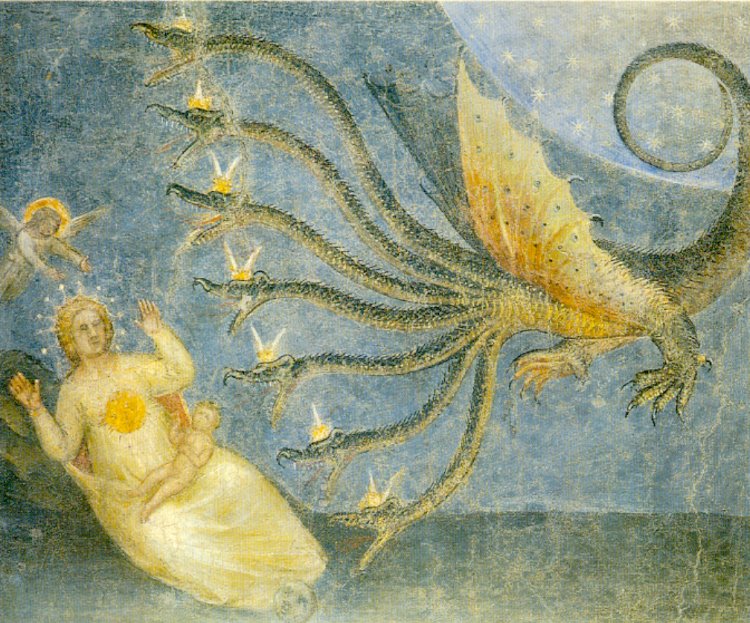
"A great portent appeared in heaven, a woman clothed with the sun" (Rev 12:1): the motherhood of Mary and of the Church.

103. The mutual relationship between the mystery of the Church and Mary appears clearly in the "great portent" described in the Book of Revelation: "A great portent appeared in heaven, a woman clothed with the sun, with the moon under her feet, and on her head a crown of twelve stars" (12:1). In this sign, the Church recognizes an image of her own mystery: present in history, she knows that she transcends history, inasmuch as she constitutes on earth the "seed and beginning" of the Kingdom of God. The Church sees this mystery fulfilled in complete and exemplary fashion in Mary. She is the woman of glory in whom God's plan could be carried out with supreme perfection.

The "woman clothed with the sun" -- the Book of Revelation tells us -- "was with child" (12:2). The Church is fully aware that she bears within herself the Savior of the world, Christ the Lord. She is aware that she is called to offer Christ to the world, giving men and women new birth into God's own life. But the Church cannot forget that her mission was made possible by the motherhood of Mary, who conceived and bore the One who is "God from God," "true God from true God." Mary is truly the Mother of God, the Theotokos, in whose motherhood the vocation to motherhood bestowed by God on every woman is raised to its highest level. Thus Mary becomes the model of the Church, called to be the "new Eve", the mother of believers, the mother of the "living."

The Church's spiritual motherhood is only achieved -- the Church knows this too -- through the pangs and "the labor" of childbirth (cf. Rev 12:2), that is to say, in constant tension with the forces of evil which still roam the world and affect human hearts, offering resistance to Christ: "In him was life, and the life was the light of men. The light shines in the darkness, and the darkness has not overcome it" (Jn 1:4-5).

Like the Church, Mary too had to live her motherhood amid suffering: "This child is set ... for a sign that is spoken against -- and a sword will pierce through your own soul also -- that thoughts out of many hearts may be revealed" (Lk 2:34-35). The words which Simeon addresses to Mary at the very beginning of the Savior’s earthly life sum up and prefigure the rejection of Jesus, and with him of Mary, a rejection which will reach its culmination on Calvary. "Standing by the cross of Jesus" (Jn 19:25), Mary shares in the gift which the Son makes of himself: she offers Jesus, gives him over, and begets him to the end for our sake. The "yes" spoken on the day of the Annunciation reaches full maturity on the day of the Cross, when the time comes for Mary to receive and beget as her children all those who become disciples, pouring out upon them the saving love of her Son: "When Jesus saw his mother, and the disciple whom he loved standing near, he said to his mother, ‘Woman, behold, your son!'" (Jn 19:26).

"And the dragon stood before the woman ... that he might devour her child when she brought it forth" (Rev 12:4): life menaced by the forces of evil.

104. In the Book of Revelation, the "great portent" of the "woman" (12:1) is accompanied by "another portent which appeared in heaven": "a great red dragon" (Rev 12:3), which represents Satan, the personal power of evil, as well as all the powers of evil at work in history and opposing the Church's mission.

Here too Mary sheds light on the Community of Believers. The hostility of the powers of evil is, in fact, an insidious opposition which, before affecting the disciples of Jesus, is directed against his mother. To save the life of her Son from those who fear him as a dangerous threat, Mary has to flee with Joseph and the Child into Egypt (cf. Mt 2:13-15).

Mary thus helps the Church to realize that life is always at the center of a great struggle between good and evil, between light and darkness. The dragon wishes to devour "the child brought forth" (cf. Rev 12:4), a figure of Christ, whom Mary brought forth "in the fullness of time" (Gal 4:4) and whom the Church must unceasingly offer to people in every age. But in a way that child is also a figure of every person, every child, especially every helpless baby whose life is threatened, because -- as the Council reminds us -- "by his Incarnation the Son of God has united himself in some fashion with every person." It is precisely in the "flesh" of every person that Christ continues to reveal himself and to enter into fellowship with us, so that rejection of human life, in whatever form that rejection takes, is really a rejection of Christ. This is the fascinating but also demanding truth which Christ reveals to us and which his Church continues untiringly to proclaim: "Whoever receives one such child in my name receives me" (Mt 18:5); "Truly, I say to you, as you did it to one of the least of these my brethren, you did it to me" (Mt 25:40).

"Death shall be no more" (Rev 21:4): the splendor of the Resurrection.

105. The angel's Annunciation to Mary is framed by these reassuring words: "Do not be afraid, Mary" and "with God nothing will be impossible" (Lk 1:30, 37). The whole of the Virgin Mother's life is in fact pervaded by the certainty that God is near to her and that he accompanies her with his providential care. The same is true of the Church, which finds "a place prepared by God" (Rev 12:6) in the desert, the place of trial but also of the manifestation of God's love for his people (cf. Hos 2:16). Mary is a living word of comfort for the Church in her struggle against death. Showing us the Son, the Church assures us that in him the forces of death have already been defeated: "Death with life contended: combat strangely ended! Life's own Champion, slain, yet lives to reign."

The Lamb who was slain is alive, bearing the marks of his Passion in the splendor of the Resurrection. He alone is master of all the events of history: he opens its "seals" (cf. Rev 5:1-10) and proclaims, in time and beyond, the power of life over death. In the "new Jerusalem," that new world towards which human history is travelling, "death shall be no more, neither shall there be mourning nor crying nor pain any more, for the former things have passed away" (Rev 21:4).

And as we, the pilgrim people, the people of life and for life, make our way in confidence towards "a new heaven and a new earth" (Rev 21:1), we look to her who is for us "a sign of sure hope and solace."
O Mary, bright dawn of the new world, Mother of the living, to you do we entrust the cause of life.

Look down, O Mother, upon the vast numbers of babies not allowed to be born, of the poor whose lives are made difficult, of men and women who are victims of brutal violence, of the elderly and the sick killed by indifference or out of misguided mercy.

Grant that all who believe in your Son may proclaim the Gospel of life with honesty and love to the people of our time.

Obtain for them the grace to accept that Gospel as a gift ever new, the joy of celebrating it with gratitude throughout their lives and the courage to bear witness to it resolutely, in order to build, together with all people of good will, the civilization of truth and love, to the praise and glory of God, the Creator and lover of life
. Amen.
-- John Paul II
This Mother's Day, let us all say with Blessed Karol Wojtyla, the Servant of God Pope John Paul the Great of happy memory, “Totus tuus ego sum et omnia mea tua sunt. Accipio te in mea omnia. Praebe mihi cor tuum, Maria." (I belong entirely to you, and all that I have is yours. I take you for my all. O Mary, give me your heart.)

Sunday, May 8, 2011

Immaculate Mary, the Virgin Mother

May is the month of Mary, and today is Mother's Day. So what better time than now to discuss our Blessed Mother Mary?

The Marian doctrines really say more about Jesus than it does about Mary herself. That is because, in all things, just as when she said at Cana, "do whatever He says," Mary always points us toward her Son.

But, at the same time, Mary also points towards ourselves. Or, more accurately, she points us to the people that God made us to be, the people we should strive to be. The entire life of Mary is not only a model, but the model for all of us. Her entire life, not merely her earthly life, but her eternal life is a model as well.
(1) Immaculate Conception – Full of Grace – Mary is the “New Eve,” who was redeemed and given the life of grace from the first moment of her conception, so that she was preserved from Original Sin or other sin in her life. The grace won by Christ on the Cross was applied to Mary in anticipation of this saving event. In this way, Mary could be a proper and pure “living temple” for the Son of God in her womb. “She is the living house of God, who does not dwell in buildings of stone but in the heart of living man.” – Pope Benedict XVI. It was this fullness of grace that gave Mary the total freedom, unimpaired by the errors of sin, to say “yes” to God at the Annunciation and throughout her life.

(2) Ever Virgin – The virgin birth of Jesus goes beyond merely demonstrating that the true Father of Jesus is God, not a man. Mary gave herself to God completely, in the entirety of her being, soul and body, including her perpetual virginity. This means that Mary was a virgin before the conception and birth of Jesus, during these events, and after these events. At once virgin and mother, Mary is the symbol and the most perfect realization of the Church, our pure and holy mother of all on earth, truly made in the image and likeness of the Triune God, a loving communion of persons that brings new life.

(3) Theotókos, the Mother of God – Mary is not merely mother of Jesus in His humanity or merely mother of the Christ, but is rightly called the Mother of God because Jesus is one, both fully human and fully God. The Lord dwelling within her, she is a living temple and Ark of the Covenant.

(4) Bodily Assumption into Heaven – At the end of her earthly life, Mary was assumed, body and soul, into heaven. She did not experience the corruption of the grave. Jesus being eternal, just as He is forever on the Cross, so too is He forever in the womb of Mary. And she is forever joined to her Son, so that if He is in heaven in the entirety of His being, soul and body, so too must His Mother Mary be in heaven in the entirety of her being, soul and body. The bodily assumption of Mary also points the way to all the faithful in the resurrection of the body.


When he appears to Mary, the angel calls her "Full of Grace," as if that were her name. "Full of grace" describes not only who she is, but what she is. And it was the fullness of grace that gave Mary the total freedom, being unimpaired by the errors of sin, to say “yes” to God, in the fullness of her being, at the Annunciation and throughout her life.

Mary was not a mother in spite of her virginity, rather, she is a mother because of her virginity. In her perpetual virginity, she gave the entirety of herself to God, and it was because of the pureness and fullness of that love that Mary’s relationship with God was not only unitive, bringing her into communion with Him, but fruitful, such that a virgin could conceive and bear a Child.* In the mystery that is the all-powerful God who is in need of nothing yet choosing to need our help in the work of salvation, Mary, the New Eve, Virgin Mother of God and model of love, gave her very body to the Redeemer, without which there would have been no salvation.

In her fiat, Mary’s loving "Yes," the Handmaid of the Lord intimately carried Jesus within her very self. She clothed Him, fed Him, cared for Him, and followed Him even unto the Cross, where her heart was pierced, but where she also was made a gift to us all as our own "mother."

This same sacrifice of Jesus on the Cross, and His subsequent Resurrection, which, being eternal, that is, beyond human time, "worked backward" to the very conception of Mary in the womb of her holy mother Anne, so as to preserve her from Original Sin (the Immaculate Conception), also "worked forward" to the end of the Virgin's earthly journey, such that she might immediately know the resurrection of the body, rather than her body having to wait to the end of human time for the resurrection (bodily Assumption into heaven).

Mary is the "new Eve," the new mother of all of those who are truly living, that is, those who have eternal life. Just as she was our model in her earthly life, so too is Mary, now in the New Jerusalem, our model for eternal life. While we were not immaculately conceived in this worldly life, the faithful will be made pure so as to be immaculately conceived into eternal life.

She, the Queen of Heaven who is "with child" and "clothed with the sun," is the eschatological destiny for all the faithful. (Rev. 12:1-2) The bodily assumption of Mary into heaven anticipates the resurrection of the body of all of the faithful into a life full of grace in communion with He who is Love and Truth. We will not be bodily assumed into heaven, but we do profess a belief in the resurrection of the body. We who "die" in Christ Jesus will see our own bodies rise with Him in His Resurrection. On the last day, the old world will pass away, and those who remain faithful to Him, who are privileged to make themselves clean and pure in the Blood of the Lamb, will be raised up and given glorified bodies, fit to inhabit the New Jerusalem where Mary now dwells.
_________________

* Mary is the model of love. And through Mary, although so very little is said about him in the Gospels, we can see that her husband Joseph is also a model of love – true love – not the false so-called “love” of feelings and emotions, of merely making himself happy, of satisfying his own wants and desires, but true and complete love, the intense thirsting of purified eros and sacrificial gift of self of agape. The spousal love of Joseph for Mary, and the spousal love of Mary for Joseph, was made complete by their spousal love for God, and it was in that fullness of love that the virginal marriage of Joseph and Mary was both unitive and procreative. (See Bl. John Paul II, Theology of the Body)

The spousal meaning of the human body, male and female, is not merely one of complimentariness, but shows that we are made for relationships that are (a) unitive, which brings about, not simply a partnership, but communion with the other, a mystical transcendental joining with the other such that many become one, and (b) creative, a fruitfulness that is not limited to the biological (sexual), but is transcendent – it was by the love of the Logos that the universe itself was created, and it is by the fruitfulness of love that Jesus transforms death on the Cross into eternal life. In this way, although Mary and Joseph never “consummated” the marriage in the flesh (i.e. sexually), one can say that the marriage was a real marriage, made complete and whole spiritually, in the spirit of love. Their virginal marriage was unitive and fruitful in that very virginity, i.e. in their complete gift of self to God and, therefore, complete gift to each other, intimately receiving the other’s heart into his or her own person in the fullness of love.

The Holy Family is the “Church in miniature” and, together with Jesus, Joseph and Mary mirror the Trinity, a loving communion of three persons in one family, one body. Their spousal love resulted not only in communion with each other and God, but was fruitful — not only the Child they raised together and shared in spirit, if not the flesh (cf. St. Augustine, De nuptiis et concupiscentia, I:12-13), but also all those children who call His Father their Father.

__________________________

See also, The Blessing of the Virgin Mary, Mother of God

(cross-posted at Vita Nostra in Ecclesia - also, some material has been previously posted)
.

Thursday, February 17, 2011

A Prayer and Litany

Oh ever Immaculate Virgin, Mother of Mercy, Health of the Sick, Refuge of Sinners, Comfortess of the Afflicted, you know our wants, our troubles, our sufferings. Look upon us with mercy. When you appeared in the grotto at Massabielle, you made it a privileged sanctuary where you dispense your favors, and where many sufferers have obtained the cure of their infirmities, both spiritual and corporal. We come, therefore, with unbounded confidence to implore your maternal intercession. Our loving Mother, obtain our request. We will try to imitate your virtues so that we may one day share your company and bless you in eternity. Amen.
Our Lady of Lourdes, help of Christians; Pray for us.
Our Lady of Lourdes, source of love; Pray for us.
Our Lady of Lourdes, mother of the poor; Pray for us.
Our Lady of Lourdes, mother of the handicapped; Pray for us.
Our Lady of Lourdes, mother of orphans; Pray for us.
Our Lady of Lourdes, mother of all children; Pray for us.
Our Lady of Lourdes, mother of all nations; Pray for us.
Our Lady of Lourdes, mother of the Church; Pray for us.
Our Lady of Lourdes, friend of the lonely; Pray for us.
Our Lady of Lourdes, comforter of those who mourn; Pray for us.
Our Lady of Lourdes, shelter of the homeless; Pray for us.
Our Lady of Lourdes, guide of travelers; Pray for us.
Our Lady of Lourdes, strength of the weak; Pray for us.
Our Lady of Lourdes, refuge of sinners; Pray for us.
Our Lady of Lourdes, comforter of the suffering; Pray for us.
Our Lady of Lourdes, help of the dying; Pray for us.
Blessed Virgin Mary, who can worthily repay you with praise and thanks for having rescued a fallen world by your generous consent! Receive our gratitude, and by your prayers obtain the pardon of our sins. Take our prayers into the sanctuary of heaven and enable them to make our peace with God.

Hail, Holy Queen, Mother of mercy, our life, our sweetness and our hope. To you do we cry, poor banished children of Eve. To you do we send up our sighs, mourning and weeping in this valley of tears. Turn then, most gracious advocate, thine eyes of mercy toward us, and after this, our exile, show unto us the blessed Fruit of thy womb, Jesus. O clement, O loving, O sweet Virgin Mary.
Pray for us, O holy Mother of God,
That we may be made worthy of the promises of Christ.

--For Marilyn and all who are in need of the loving embrace of our Blessed Mother.
Holy Mary, Mother of God, pray for her
St. Joseph, pray for her
St. Bernadette, pray for her
St. Padre Pio, pray for her
St. Andre Bessette, pray for her
Venerable John Paul II, pray for her
.

Friday, February 11, 2011

The Prayer in the Grotto

Immaculate Mary, pray for us.
St. Bernadette, pray for us.

The Immaculate Conception and Healing the Sick

Today is the Feast Day of Our Lady of Lourdes. It was on February 11, 1858, that the Lady in White appeared to the humble Bernadette Soubirous at Massabielle in Lourdes, France.

Later, on March 25 (Solemnity of the Annunciation), the Lady said, "I am the Immaculate Conception." When Bernadette reported this, the particular phraseology confounded some people. They did not have trouble with the "Immaculate Conception" part, but with the "I am . . ." part. They thought that Bernadette must have misstated the message and that the Lady must have instead said something like "I am immaculately conceived" or "I am the Virgin of the Immaculate Conception," reasoning that one cannot be her own conception, she cannot conceive herself.

But is that particular way of identification, "I am the Immaculate Conception," really all that illogical? Being "full of grace," the Blessed Virgin is, by her very nature, both pure and ever-new. The term "Immaculate Conception" describes not merely an event or process, but describes who and what Mary is. She is, in her being, immaculate and pure, and as the holy mother of He who "makes all things new," being now eternally joined with Him in spirit and body, she too is eternally new.

And it is because Mary is the Immaculate Conception, and not merely the product of an immaculate conception, that, through her at Lourdes and elsewhere, combined with the loving prayers of the faithful, the sick might also be made new and healed. There have been 67 cases of miraculous medical cures recognized by the Church and countless other cures that are as yet "unexplained." Here is a list of those 67 people physically healed at Lourdes (pdf file). Of course, there have been many, many more people who have received spiritual healing or been strengthened in the faith due to Our Lady of Lourdes.
"Lourdes should not be reduced to the alternatives - miracle or no a miracle. For the Church, as well as for the believer, a pilgrimage to Mary is more than a journey to a miracle. It is a journey of love, of prayer and of the suffering community."
-- Professor François-Bernard Michel, Co-Chairman of the International Medical Committee of Lourdes

The Virgin's maternal care for the sick and suffering is one of the many messages of Lourdes, messages of faith, hope, and love.

Homily of Pope Benedict XVI
Memorial of Our Lady of Lourdes

18th World Day of the Sick
February 11, 2010

The Gospels, in the synthetic descriptions of the brief but intense public life of Jesus, attest that He proclaimed the Word and healed the sick, a sign par excellence of the closeness of the Kingdom of God. For example, Matthew writes: "And He went about all Galilee, teaching in their synagogues and preaching the gospel of the kingdom and healing every disease and every infirmity among the people" (Matthew 4:23; cf 9:35). The Church, which has been entrusted with the task of prolonging the mission of Christ in space and time, cannot neglect these two essential works: evangelization and care of the sick in body and spirit. God, in fact, wishes to heal the whole man, and in the Gospel the healing of the body is a sign of a more profound healing, which is the remission of sins (cf Mark 2:1-12).

Hence, it is not surprising that Mary, Mother and model of the Church, is invoked and venerated as "salus infirmorum," "health of the sick." As first and perfect disciple of her Son, she has always shown, accompanying the journey of the Church, special solicitude for the suffering. Testimony of this is given by the thousands of people who go to Marian shrines to invoke the Mother of Christ, and find strength and relief.

The Gospel narrative of the Visitation (cf. Luke 1:39-56) shows us how the Virgin, after the evangelical announcement, did not keep to herself the gift received, but left immediately to go to help her elderly cousin Elizabeth, who for six months had been carrying John in her womb. In the support given by Mary to this relative who was, at an advanced age, living a delicate situation such as pregnancy, we see prefigured the whole action of the Church in support of life in need of care. . . .

A most affectionate welcome goes naturally to you, dear sick people. Thank you for coming and above all for your prayer, enriched with the offer of your toil and sufferings. And my greeting goes also to the sick and volunteers joining us today from Lourdes, Fatima, Czestochowa and from other Marian shrines, and to all those following us on radio and television, especially from clinics or from their homes. May the Lord God, who constantly watches over his children, give everyone relief and consolation.

Today's Liturgy of the Word presents two main themes: the first is of a Marian character, and it unites the Gospel and the first reading, taken from the last chapter of the Book of Isaiah, as well as the Responsorial Psalm, taken from Judith's canticle of praise. The other theme, which we find in the passage of the Letter of James, is of the prayer of the Church for the sick and, in particular, of the sacrament reserved for them.

In the memorial of the apparitions of Lourdes, a place chosen by Mary to manifest her maternal solicitude for the sick, the liturgy appropriately makes the Magnificat resonate, the canticle of the Virgin who exalts the wonders of God in the history of salvation: the humble and the indigent, as all those who fear God, experience His mercy, He who reverses earthly fortunes and thus demonstrates the holiness of the Creator and Redeemer. The Magnificat is not the canticle of those on whom fortune smiles, who always "prosper," rather it is the thanksgiving of those who know the tragedies of life, but trust the redeeming work of God. It is a song that expresses the tested faith of generations of men and women who have placed their hope in God and have committed themselves personally, like Mary, to being of help to brothers in need. In the Magnificat, we hear the voice of so many men and women saints of charity, I am thinking in particular of those who consumed their lives among the sick and suffering, such as Camillus of Lellis and John of God, Damien de Veuster and Benito Menni. Whoever spends a long time near persons who suffer, knows anguish and tears, but also the miracle of joy, fruit of love.

The maternity of the Church is a reflection of the solicitous love of God, of which the prophet Isaiah speaks: "As one whom his mother comforts, so I will comfort you; you shall be comforted in Jerusalem" (Isaiah 66:13).

A maternity that speaks without words, which arouses consolation in hearts, a joy that paradoxically co-exists with pain, with suffering. Like Mary, the Church bears within herself the tragedies of man, and the consolation of God, she keeps them together, in the course of her pilgrimage in history. Across the centuries, the Church shows the signs of the love of God, who continues to do great things in humble and simple people.

Suffering that is accepted and offered, a sharing that is sincere and free, are these not, perhaps, miracles of love? The courage to face evils unarmed -- as Judith -- with the sole strength of faith and of hope in the Lord, is this not a miracle that the grace of God arouses continually in so many persons who spend time and energy helping those who suffer?

For all this, we live a joy that does not forget suffering, on the contrary, it includes it. In this way, the sick and all the suffering are in the Church, not only as recipients of attention and care, but first and above all, protagonists of the pilgrimage of faith and hope, witnesses of the prodigies of love, of the paschal joy that flowers from the cross and the resurrection of Christ.

In the passage of the Letter of James just proclaimed, the Apostle invites awaiting with constancy the already close coming of the Lord and, in this context, addresses a particular exhortation to the sick. This context is very interesting, because it reflects the action of Jesus, who, curing the sick, showed the closeness of the Kingdom of God.

Sickness is seen in the perspective of the end times, with the realism of hope that is typically Christian. "Is any one among you suffering? Let him pray. Is any cheerful? Let him sing praise" (James 5:13). We seem to hear similar words in St. Paul, when he invites us to live everything in relation to the radical news of Christ, his death and resurrection (cf. 1 Corinthians 7:29-31).

"Is any among you sick? Let him call for the elders of the church, and let them pray over him, anointing him with oil in the name of the Lord; and the prayer of faith will save the sick man, and the Lord will raise him up; and if he has committed sins, he will be forgiven" (James 5:14-15).

Evident here is the prolongation of Christ in His Church; He is always the one who acts through the presbyters; it is His same Spirit that operates through the sacramental sign of the oil; it is to Him that faith is directed, expressed in prayer; and, as happened with the persons cured by Jesus, one can say to each sick person: Your faith, supported by the faith of brothers and sisters, has saved you.

From this text, which contains the foundation and practice of the Sacrament of the Anointing of the Sick, is extracted at the same time a vision of the role of the sick in the Church: An active role as it "provokes," so to speak, prayer made with faith.

"Is any among you sick? Let him call for the elders of the church." In this Year for Priests, I wish to stress the bond between the sick and priests, a sort of alliance, of evangelical "complicity." Both have a task: The sick person must "call" the presbyters, and they must respond, to bring upon the experience of sickness the presence and action of the Risen One and of his Spirit.

And here we can see all the importance of the pastoral care of the sick, the value of which is truly incalculable, because of the immense good it does in the first place to the sick person and to the priest himself, but also to relatives, to friends, to the community and, through hidden and unknown ways, to the whole Church and to the world. In fact, when the Word of God speaks of healing, of salvation, of the health of the sick, it understands these concepts in an integral sense, never separating soul and body: A sick person cured by Christ's prayer, through the Church, is a joy on earth and in heaven, a first fruit of eternal life.

Dear friends, as I wrote in the encyclical "Spe Salvi," "The true measure of humanity is essentially determined in relationship to suffering and to the sufferer" (No. 38). By instituting a dicastery dedicated to health care ministry, the Church also wished to make her own contribution to promote a world capable of receiving and looking after the sick as persons. In fact, she has wished to help them to live the experience of sickness in a human way, without denying it, but giving it a meaning.

I would like to end these reflections with a thought of the Venerable Pope John Paul II, to which he gave witness with his own life. In the apostolic letter "Salvifici Doloris," he wrote: "At one and the same time, Christ has taught man to do good by His suffering and to do good to those who suffer."

May the Virgin Mary help us to live this mission fully. Amen!


(Relics of St. Bernadette Soubirous were present at the Mass at St. Peter's Basilica.)

.

Tuesday, February 8, 2011

Bernadette and Suffering

Growing up, Bernadette was often sickly and physically weak due to severe asthma and other maladies, not to mention undernourishment due to poverty. She was able to obtain some relief during those times when her parents sent her to the home of her foster-mother, Marie (Aravant) Laguës, who lived in the country, but Bernadette wanted to come home to Lourdes, especially so that she could make her First Communion. And her health was always worse when she was in Lourdes.

So it was when she went to Massabielle and encountered the Lady she called "Aquéro." The Lady later told Bernadette to dig at a spot in the grotto, and from that spot, a spring of water appeared -- water which later would be used in the miraculous cures of many sick people. But Bernadette was not one of those to be cured. After she entered the convent at Nevers, she was frequently in bed in the infirmary, and she received the Sacrament of Annointing multiple times because she was near death.

In addition to the question of, "Why should the Blessed Virgin appear to one such as Bernadette?" There is also the question of "Why didn't the waters of Lourdes heal Bernadette?"


"O Jesus and Mary, let my entire consolation in this world be to love you and to suffer for sinners."
--Bernadette

Actually, it is not entirely the case that Bernadette is not among the miraculously healed of Lourdes. Although her body failed her in this worldly existence, when she was exhumed several years after her death as part of the beatification and canonization process, Bernadette's body was found to be, like her Lady, preserved from corruption.

Saturday, February 5, 2011

From Massabielle the Blessed Virgin speaks to us too

The motto of Pope John Paul II was "totus tuus" (totally yours), reflecting his profoundly personal devotion to the Mary. The phrase is from the book True Devotion to Mary, by Saint Louis de Montfort, and the complete text is, "Totus tuus ego sum, et omnia mea tua sunt" (I am all yours, and all that I have is yours).

Five months before he passed from this world, the Pope journeyed to Lourdes to pray at Massabielle, where the Blessed Virgin had appeared and spoke to Bernadette. At the time, John Paul counted himself among the sick and suffering. About a month after he made his pilgrimmage to Lourdes, I saw the Holy Father in my own pilgrimmage to Rome. His Parkinson's disease pressed down upon him like a heavy cross, making his movements and speech very difficult.

John Paul spent his entire papacy teaching us with words, but in the last few years and months of his life, when the words were difficult to say, he taught us with his very being, with the model of grace and dignity that he presented to the world while in the midst of suffering. He taught us that, with Mary standing there with us, as we suffer on our own personal crosses, we too might have the grace of healing, not merely the physical healing that some have received at Lourdes, but the ultimate healing, eternal life with the Lord.


Homily of the Venerable Servant of God John Paul II
Apostolic Pilgrimage to Lourdes
Solemnity of the Assumption of Mary
August 15, 2004

1. "Que soy era Immaculada Councepciou." The words which Mary spoke to Bernadette on 25 March 1858 have a particular resonance this year, as the Church celebrates the 150th anniversary of the solemn definition of the dogma of the Immaculate Conception by Blessed Pius IX in the Apostolic Constitution Ineffabilis Deus.

I have greatly wished to make this pilgrimage to Lourdes in order to celebrate an event which continues to give glory to the Triune God. Mary’s Immaculate Conception is the sign of the gracious love of the Father, the perfect expression of the redemption accomplished by the Son and the beginning of a life completely open to the working of the Spirit.

2. Beneath the maternal gaze of the Blessed Virgin, I offer a heartfelt greeting to all of you, dear brothers and sisters, as we gather before the Grotto of Massabielle to sing the praises of her whom all generations call blessed (cf. Lk 1:48). . . .

With special affection I greet the sick and all who have come to this holy place to seek consolation and hope. May the Blessed Virgin enable you to sense her presence and give comfort to your hearts!

3. "In those days Mary arose and went with haste into the hill country..." (Lk 1:39). The words of the Gospel story have once more brought before the eyes of our hearts the young maiden of Nazareth as she makes her way to that "city of Judah" where her kinswoman Elizabeth lived, in order to be of help to her.

What strikes us about Mary is above all her loving concern for her elderly relative. Hers is a practical love, one which is not limited to words of understanding but is deeply and personally involved in giving help. The Blessed Virgin does not merely give her cousin something of herself; she gives her whole self, asking nothing in return. Mary understood perfectly that the gift she received from God is more than a privilege; it is a duty which obliges her to serve others with the selflessness proper to love.

4. "My soul magnifies the Lord..." (Lk 1:46). Mary’s sentiments in her meeting with Elizabeth are forcefully expressed in the canticle of the Magnificat. Her words convey the hope-filled expectation of the "poor of the Lord" and at the same time an awareness that God has fulfilled his promises, for He "has remembered His mercy" (cf. Lk 1:54).

This same awareness is the source of that joy of the Virgin Mary which pervades the whole canticle: joy in knowing that she has been "looked upon" by God despite her own "lowliness" (cf. Lk 1:48); joy in the "service" she is able to offer because of the "great things" to which the Almighty has called her (cf. Lk 1:49); joy in her foretaste of the eschatological blessedness promised to "those of low degree" and "the hungry" (cf. Lk 1:52-53).

The Magnificat is followed by silence: nothing is said to us about the three months that Mary stayed with her kinswoman Elizabeth. Yet perhaps we are told the most important thing: that goodness works quietly, the power of love is expressed in the unassuming quietness of daily service.

5. By her words and her silence the Virgin Mary stands before us as a model for our pilgrim way. It is not an easy way: as a result of the fall of our first parents, humanity is marked by the wounds of sin, whose consequences continue to be felt also among the redeemed. But evil and death will not have the last word! Mary confirms this by her whole life, for she is a living witness of the victory of Christ, our Passover.

The faithful have understood this. That is why they throng to this grotto in order to hear the maternal counsels of the Blessed Virgin. In her they acknowledge "the woman clothed in the sun" (Rev 12:1), the Queen resplendent before the throne of God (cf. Responsorial Psalm), ever interceding on their behalf.

6. Today the Church celebrates Mary’s glorious Assumption body and soul into Heaven. The two dogmas of the Immaculate Conception and the Assumption are closely related. Both proclaim the glory of Christ the Redeemer and the holiness of Mary, whose human destiny is even now perfectly and definitively realized in God.

"When I go and prepare a place for you, I will come again and will take you to myself, that where I am, there you may be also" (Jn 14: 3). Mary is the pledge of the fulfilment of Christ’s promise. Her Assumption thus becomes for us "a sign of sure hope and consolation" (cf. Lumen Gentium, 68).

7. Dear brothers and sisters! From this grotto of Massabielle the Blessed Virgin speaks to us too, the Christians of the third millennium. Let us listen to her!

Listen to her, young people who seek an answer capable of giving meaning to your lives. Here you can find that answer. It is a demanding one, yet it is the only answer which is genuinely satisfying. For it contains the secret of true joy and peace.

From this grotto I issue a special call to women. Appearing here, Mary entrusted her message to a young girl, as if to emphasize the special mission of women in our own time, tempted as it is by materialism and secularism: to be in today’s society a witness of those essential values which are seen only with the eyes of the heart. To you, women, falls the task of being sentinels of the Invisible! I appeal urgently to all of you, dear brothers and sisters, to do everything in your power to ensure that life, each and every life, will be respected from conception to its natural end. Life is a sacred gift, and no one can presume to be its master.

Finally, Our Lady of Lourdes has a message for everyone. Be men and women of freedom! But remember: human freedom is a freedom wounded by sin. It is a freedom which itself needs to be set free. Christ is its liberator; He is the one who "for freedom has set us free" (cf. Gal 5:1). Defend that freedom!

Dear friends, in this we know we can count on Mary, who, since she never yielded to sin, is the only creature who is perfectly free. I entrust you to her. Walk beside Mary as you journey towards the complete fulfilment of your humanity!

Saturday, January 29, 2011

Bernadette Soubirous - Humility, Innocence, and Grace

Marie Bernarde (Bernadette) Soubirous was a very poor, unsophisticated, peasant girl. She was born January 7, 1844, and baptized the next day.

Bernadette was sensitive, with a pleasant and humble disposition, but, perhaps due to her poverty, she was undersized, and often physically weak due to asthma. Marie (Aravant) Laguës, foster-mother, said, "As a baby, Bernadette was already very loveable, the neighbors loved to see her and to hold her in their arms." Further,
"Bernadette, in spite of the tiredness which was caused by her shortness of breath and difficulty in breathing, always appeared happy and cheerful. She never gave us any trouble, she took what she was given, and appeared happy. We loved her very much as well."
Abbé Pène, Curate of the Parish of Lourdes in 1858, said that "everything about Bernadette radiated naïveté, simplicity, goodness."

In this sweet innocence and goodness, Bernadette was also widely thought to be backward and slow, including in her ability to learn the faith. By age 14, she still had not made her First Holy Communion. Her teacher, Jean Barbet, reported that
"Bernadette has difficulty to retain the Catechism word by word, because she cannot study, she does not know how to read, but she puts a lot of care into the appropriate meaning of the explanations. Besides, she is very attentive, above all very pious and modest."
Marie Laguës likewise stated,
"It was useless to for me to repeat my lessons; I always had to begin again. Sometimes I was overcome by impatience and I would throw my book aside and say to her, 'Go along, you will never be anything but a little fool.'"
Meanwhile, that era saw the rise of various corrosive secular humanist ideologies, including an exaggerated exultation of science against religion. France, in particular, was rampant with anti-clericalism, with substantial hostility being expressed toward the Catholic Church by the intellectual elite.

Young Bernadette, though, knew nothing of these ideologies and controversies. It was in her simple life that, on February 11, 1858, a Lady in White appeared to the 14-year-old Bernadette at Massabielle, a grotto on the bank of the Gave River near Lourdes, France. The Lady was young and no larger than Bernadette's own diminutive stature. Bernadette later recounted:
"I heard a sound like a gust of wind. . . . As I raised my head to look at the grotto, I saw a Lady dressed in white, wearing a white dress, a blue girdle and a yellow rose on each foot."
On this first apparition, the Lady asked the girl to make the sign of the Cross piously and say the rosary with her. Bernadette saw the Lady, whom she called "Aquéro" (meaning "that" or "the one" in her native Pyrenees dialect), take the rosary that was hanging from her arms into her hands. This was repeated in subsequent apparitions. There were 18 appearances in all, lasting from February 11 to July 16, 1858.

During the visions, the Lady requested prayer and penitence, asked for the construction of a new church and a procession, and led Bernadette to a fresh water spring that is believed to have miraculous healing powers. Despite strong doubt and even opposition from political and church officials, including being detained for a time and questioned by the local police, Bernadette's faith in what she had witnessed remained steadfast and humble.

At first, the Lady did not identify herself, despite being asked. Although others were quick to identify her as the Blessed Virgin Mary, Bernadette expressly did not make that claim, continuing instead to refer to her as "Aquéro" or "the Lady." However, Bernadette reports that, at the 16th appearance,
"The Lady was standing above the rose-tree, in a position very similar to that shown in the miraculous medal. At my third request her face became very serious and she seemed to bow down in an attitude of humility. Then she joined her hands and raised them to her breast . . . She looked up to heaven . . . then slowly opening her hands and leaning forward towards me, she said to me in a voice vibrating with emotion, 'Que soy era Immaculada Concepciou' (I am the Immaculate Conception)."
Before that time, Bernadette had not heard of the words, much less the doctrine of, "Immaculate Conception," which itself is grounded in simple humility and grace. And even when she heard the words, she did not know what they meant.

Some of these happenings took place in the presence of many people, but no one besides Bernadette claimed to see or hear the Lady, and there was no disorder or emotional extravagance. However, reports of miraculous cures occurring at the grotto spread quickly and the more they spread, the greater the number of people who visited Massabielle. These included pious believers, sick people desperate for cures, curiosity seekers, skeptics and scoffers.

The publicity given these miraculous events and the manifest sincerity and innocence of the girl on the one hand, and the compelling need to protect the faith and the faithful from the scandal of fraudulent claims on the other, made it necessary for the Bishop of Tarbes, Bertrand Severe Laurence, to institute a judicial inquiry as to the authenticity, or lack thereof, of the apparitions. This inquiry required Bernadette to submit to intense questioning on multiple occasions. And, during those sessions, as had happened in the interrogation by the local magistrate during the apparitions, the ecclesiastical questioners would occasionally try to trap Bernadette or trick her into contradicting herself or otherwise show that she was lying or delusional. Each time they did this, however, Bernadette only proved herself to be more credible and sincere.

Four years later, he declared the apparitions to be supernatural and worthy of belief, and public veneration of the Immaculate Conception in the grotto was allowed. Bishop Laurence said of Bernadette,
"The testimony of the young girl is in every way as satisfactory as possible. To begin with, her sincerity cannot be doubted. Who that has questioned her can fail to admire the simplicity, the candour, the modesty of this child? Whilst everyone is talking about the wonders which have been revealed to her, she alone keeps silence. She only speaks when she is questioned and then she recounts everything without affectation and with a touching simplicity, and she replies to the numerous questions addressed to her without hesitation, giving answers clear and precise, very much to the point and bearing the stamp of intense conviction. She has been tested most severely but no menaces have ever shaken her; she has responded to the most generous offers by a noble disinterestedness. She never contradicts herself; in all the different examinations which she has undergone, her story never varies; she never adds to it or takes away from it. Bernadettes sincerity cannot then be disputed. we may add that it never has been disputed; even her opponents, when she has had opponents, have paid her that homage."
Soon the requested chapel was erected, and since that time numberless pilgrims come every year to Lourdes to fulfill promises or to beg graces.

For some years after, in addition to her poor health, Bernadette suffered greatly from the suspicious disbelief of some and the tactless enthusiasm, insensitive attentions, and outright harassment by others. Sometimes people would ask her to bless or touch some religious object of theirs, such as a rosary, and when she declined to do so, they would try to trick her into touching the object by feigning to accidentally dropping it on the ground, hoping that she would then pick it up for them. Bernadette bore these trials of her unwanted celebrity with impressive patience and dignity, although there were times when it frustrated her. She was especially uncomfortable with those who treated her as holy,
"They think I'm a saint . . . When I'm dead, they'll come and touch holy pictures and rosaries to me, and all the while I'll be getting broiled on a grill in purgatory. At least promise me you'll pray a lot for the repose of my soul."
Bernadette never sought publicity or name and fame, and she did not enjoy it when these things came, but despite the occasional giving into annoyance, overall, she bore those burdens with great grace. In her private notes, she wrote,
"I must die to myself continually and accept trials without complaining. I work, I suffer and I love with no other witness than his heart. Anyone who is not prepared to suffer all for the Beloved and to do his will in all things is not worthy of the sweet name of Friend, for here below, Love without suffering does not exist. . . .
"I shall spend every moment loving. One who loves does not notice her trials; or perhaps more accurately, she is able to love them."
Besides, the Lady had told Bernadette on the third apparition,"I do not promise to make you happy in this world, but in the next."

In 1866, she was admitted to the convent of the Sisters of Charity at Nevers, France. Here, Sister Marie-Bernarde was more sheltered from trying publicity, but not from the “stuffiness” of the convent superiors nor from the tightening grip of asthma.

“I am getting on with my job,” she would say. “What is that?” someone asked. “Being ill,” was the reply. Thus she lived out her self-effacing life, dying at the age of 35.

The events of 1858 resulted in Lourdes becoming one of the greatest pilgrim shrines in the history of Christendom. But St. Bernadette took no part in these developments; nor was it for her visions that she was canonized, but for the humble simplicity and religious trusting that characterized her whole life.
.